In 2019, the National Association of State Directors of Pupil Transportation Services (NASDPTS) released data from their annual national survey indicating that more than 17 million stop-arm violations occur in the United States each year. Putnam Countyhas launched a School Bus Safety Program to reduce the illegal passing of school buses and improve student safety
On August 6, 2019, New York State passed legislation (S.4524B/A.4950B) authorizing school districts to install safety cameras on school buses to catch drivers who unlawfully pass a stopped school bus and ensure student safety.
To speak to a representative about a safety violation, contact the AlertBus Customer Contact Center at 1-877-504-7080.
NYS Stopping Laws
Yellow flashing lights mean the bus is preparing to stop to load or unload children. Slow down and prepare to stop your vehicle.
Red flashing lights mean the bus has stopped for the purpose of loading or unloading children. Stop your vehicle and wait until the school bus resumes motion or until signaled by the driver or police officer to proceed.
Which school districts in Putnam County will deploy the technology across bus fleets?
Mahopac, Carmel, & Brewster school districts will be participating.
Is School Bus Safety an Issue in New York State and Putnam County?
Every day 2.3 million children are transported by school buses throughout New York State. Data has shown that an estimated 50,000 drivers throughout the State illegally pass stopped school buses on a single school day*.
In New York State, a one-month study of 10 buses in East Meadow was conducted in 2019. Cameras recorded 615 illegal passes or roughly 2.3 per bus per day. This represents three times more than the number of tickets given out by Nassau and Suffolk counties during the 2018-2019 school year.
Reducing school bus stop-arm violations will significantly contribute to student and school bus safety in and around Putnam County. The automated camera system serves as a deterrent and education tool for motorists considering breaking the law and passing a stopped school bus.
While enforcement and education are critical in helping to change behavior, current models and legal frameworks in most states require that police officers catch motorists passing a stopped school bus with its red lights flashing to issue a citation. But with roughly 560,000 school buses traveling across more than 4 million miles of road and highway in the United States, conventional methods are not enough to effectively enforce the law to control these violations across the country. In addition, it permits local law enforcement officers to focus their energies on other high-priority tasks.
The School Bus Safety Program will provide data to partner school officials and municipalities to make informed decisions on school bus safety. The stop-arm violation data can also be leveraged by local law enforcement to add a physical presence to school bus stops with higher rates of infractions.
How Does the Safety Program Reduce Illegal Passings?
Entire school bus fleets will be outfitted with the latest safety technology, including safety cameras, DVR and storage devices, GPS, telemetry, LTE connectivity, [and internal cameras.]
In addition to this cutting-edge technology, the enforcement program is powered by software and processes and overseen by experienced safety professionals who coordinate with police, local officials, and school districts.
When a school bus is stopped with its lights and stop-arm activated, cameras capture incidents involving vehicles illegally passing the bus. Through cloud computing, data is sent to trained safety experts, who then review the footage and prepare evidence packages for municipalities.
By coupling technology-based enforcement with education and public safety campaigns, motorists learn how to adjust their behavior around school buses and children.
How will Putnam County School Districts Benefit from the Safety Program?
All school districts can opt-in to the program and benefit from an advanced school bus safety suite deployed across their entire fleets at no cost to the schools, taxpayers, or Putnam County. The violator-funded safety program handles the procurement, installation, management, and maintenance of the safety technology. In addition to a targeted effort to reduce the illegal passing of school buses in the community, the school district will benefit from access to cloud-connected internal cameras and BusPatrol's AlertBus platform for live-stream video and emergency alerts.
In the run-up to the program launch, Putnam County will work with BusPatrol to execute a community education and awareness campaign, including road signage, community announcements, and warning letters. The program will be preceded by a 30-day warning period, during which warning letters will be issued to drivers who fail to stop for school buses with no monetary penalty.
Who Are Stop-Arm Violation Tickets Issued to, and How Much Will They Cost Violators?
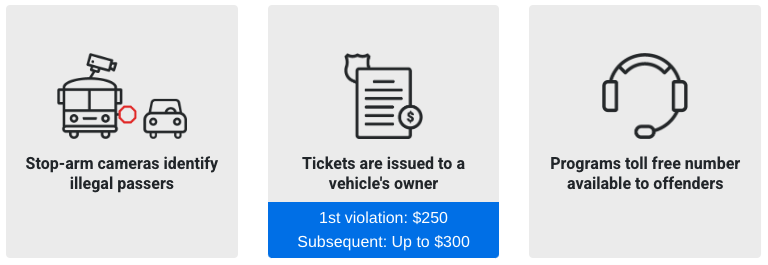
Stop-arm cameras identify illegal passers by license plate number. Tickets are issued to a vehicle's registered owner unless the automobile is proven stolen during the time of the offense. If someone other than the vehicle's owner was driving at the time, the owner can request a transfer of liability.
In most states, a first-time stop-arm violation carries a fine of $250. In New York state, subsequent violations within an eighteen-month period are subject to a $25 increase in penalty, up to a maximum of $300.
Data from other safety programs demonstrates that 98% of first-time offenders do not receive a second ticket and that 95% of drivers do not contest their ticket after seeing video evidence of their violation.
How Does It Work?
The diagram above is a representation of the camera systems used in the County. BusPatrol's leading stop-arm enforcement program is built on a robust, guided, and secure process. When a vehicle illegally passes a school bus while the stop-arm is deployed, BusPatrol's multi-lens camera box captures the violation and the car's license plates from different depths and angles. The footage, GPS, and timecode data are stored locally on an onboard digital video recorder (DVR) unique to each bus.
The data relating to the incident and violation is sent via an encrypted LTE network to BusPatrol's secure cloud system. BusPatrol's artificial intelligence software filters all footage received from each bus before it goes to one of our safety specialists for review.
A BusPatrol safety specialist reviews the filtered footage. If they determine that the violation is indeed an offense, the specialist prepares an evidence package for use by law enforcement. The package is built in accordance with state law, complete with video footage, license plate number, make, model, driver information, GPS location, and a timestamp of the incident.
The evidence package is submitted to the enforcement entity via a secure cloud portal. The enforcement entity responsible for approving violations reviews the evidence package to determine if a violation has occurred. If approved, a ticket is mailed to the vehicle's owner, along with a link to the AlertBus Driver Education & Payment Portal, where they can view video evidence of their violation. The vehicle owner makes their payment online, through the mail, or in person in the municipal jurisdiction – tickets can also be contested through the relevant jurisdiction's civil court system.
When Should I Stop for a Stopped School Bus in New York State?
When a school bus stops and flashes its red lights, traffic approaching from either direction must stop before reaching the bus:
on a two-lane road
on multi-lane highways
on divided highways
Embed NYS Stopping Law Video / Video file also available in the Video folder in this pack:
Yellow flashing lights mean the bus is preparing to stop to load or unload children. Slow down and prepare to stop your vehicle.
Red flashing lights mean the bus has stopped for the purpose of loading or unloading children. Stop your vehicle and wait until the school bus resumes motion or until signaled by the driver or police officer to proceed.
Learn more at New York DMV.
How to Behave Around School Buses in New York State
Information from DMV New York
School Buses are Unlike Other Vehicles School buses have bigger blind spots, take longer to stop, and need more room to maneuver than a standard vehicle. Buses should be treated differently than you would treat an average-sized vehicle. Drivers need to know how to react to a school bus in operation.
When you encounter a school bus:
Slow down. School buses make frequent stops, so be patient and drive at a reasonable speed. Remember, school buses are required by law to stop at railroad crossings in addition to picking up and dropping off students.
Be alert. Always be aware of children and parents waiting at a school bus stop or perhaps running to catch the bus before it departs.
Come to a complete stop at least 20 feet away from the bus.
Be extra careful to look around before moving your vehicle, as children may be walking in front of, behind, or on the side of school buses. Check for pedestrians - especially near schools, bus stops, playgrounds, parks, and behind parked cars.
Safety Tips for Children, Student Riders, and Parents
Parents: You should discuss transportation conduct and safety rules with your children and share the safety tips below.
Get to the bus stop at least five minutes before the bus arrives.
When the bus approaches, stand at least three giant steps (six feet) away from the curb and wait away from the street.
Wait until the bus stops, the door opens, and the driver says it's okay before stepping onto the bus.
If you have to cross the street in front of the bus, walk on the sidewalk or along the side of the road to a point at least five giant steps (ten feet) ahead of the bus before you cross. Be sure that the driver can see you, and you can see the bus driver.
Use the handrails to avoid falling. Be careful that clothes with drawstrings and bags with straps are not caught in the handrails or doors.
Never walk behind the bus.
After you get off the bus, walk at least three giant steps away from the side of the bus.
If you drop something near the bus, tell the bus driver. Never try to pick it up because the driver may not be able to see you.
Students can only embark or disembark at their designated stop.
Important Safety Tips for Children to Learn and Remember
Check before you step.
I see the driver. The driver sees me.
Wait for the driver's signal to cross.
Look left, right, and left again.
Use a backpack or book bag to avoid dropping things.
Horn means danger.
Learn More About School Bus Safety
The primary focus of the School Bus Stop-Arm Safety Program is public awareness and education. The success of the program is measured in the reduction of stop-arm violations over time and not by the number of vehicles caught violating the law. Please review the information regarding school bus safety and the "danger zone" below.
The following information is provided for assistance.
To speak to a representative about a stop-arm violation, contact the AlertBus Customer Contact Center at 1-877-504-7080.
The Contact Center is available Monday- Friday (8 AM – 5 PM). English, Spanish, and French-speaking, customer service agents are available to address your inquiries. Please have your Citation Number ready when you call to expedite our service.
To view the violation video evidence online or to pay a violation by credit card, visit www.alertbus.com and enter the following information: Your citation number (example: NY-777777) and vehicle license plate number (no dashes or spaces), as listed on your citation.
I am PREPARED because I take safety courses, I talk to my family, and we practice safety drills. I am READY because I have food and supplies stocked, My GoBag is packed up, and I am signed up for Weather Alerts, which makes me PREPARED & READY!
These are my friends! We are all PREPARED & READY!
Are you PREADY ?
Check and make sure that you and you family are PREADY! This interactive checklist will get you prepared and ready as you build your own PREADY, SET, GO! Emergency bag.
PUTNAM COUNTY GOVERNMENT DOES NOT REVIEW OR RETAIN ANY OF YOUR INFORMATION. IF YOU'D LIKE US TO HELP PREPARE THIS, PLEASE COMPLETE THE CHECKLIST AND CONTACT THEBUREAU OF EMERGENCY SERVICES FOR A ONE ON ONE CONSULTATION.
Let's Learn about ALERTS & WARNINGS
A quick guide to learn about Alerts & Warnings, their meaning and how to prepare for them.
[remixicon-system--alert-fill]
ADVISORY & STATEMENT
Be aware! A hazard is expected to occur in your area or nearby, but its impact is not expected to be life threatening.
[remixicon-system--alert-fill]
WATCH
Be prepared! A hazard may possibly occur in your area or nearby.
[remixicon-system--alert-fill]
WARNING
Take action! A hazard is expected to occur or is already occurring in your area or nearby, and its impact may be serious.
[microphone]
“THIS IS A TEST”
Officials sometimes send test or practice messages. Consider using this as a reminder to check your emergency plan and supplies. Review the 12 Ways to Prepare for more steps to take
Some hazards may not have an advisory, watch, or warning. Use the 12 Ways to Prepare and be Ready for hazards that may happen suddenly. Visit ready.gov/be-informed to learn more about hazards not included in this guide. This is general guidance. Always defer to the alert.
12 Ways to Prepare before disaster happens
Equip yourself with 12 ways to prepare before a disaster happens. Utilize a quick guide to learn about Alerts & Warnings, their meaning and how to prepare for them. Also, learn about how to prepare for weather events that affect our area such as Ice, Snow, Heavy Rain & High Winds.
Sign up for Alerts & Warnings
You can use various sources to stay informed about severe weather alerts, such as local news, NOAA Weather Radio, or smart phone apps. You can also check the Weather-Ready Nation website for tips and resources on how to be weather-ready.
Make a Plan
You should have a family emergency plan that includes an emergency meeting place, contact information, and escape routes. You should also identify a safe room in your home, such as a basement, storm cellar, or an interior room with no windows, where you can shelter during a severe thunderstorm, tornado, or winter storm.
Put aside funds for emergencies
You should have some cash on hand in case of power outages or other disruptions that may affect your access to banks or ATMs. You should also have an emergency fund that can cover your basic expenses for at least three months, in case you lose your income or have to relocate due to a disaster.
Practice Emergency Drills with your family
You should conduct regular drills with your family to practice what to do in case of a severe weather emergency. For example, you can practice how to get to your safe room, how to communicate with each other, and how to use your emergency supplies. You can also review your emergency plan and update it as needed. Practicing your plan will help you and your family stay calm and confident during a real emergency.
Test Your Family Communication
You should practice how to contact each other and where to meet in case of an emergency. You should also test your emergency alert systems and devices, such as radios, phones, or apps.
Safeguard Documents
You should keep a binder of important papers, such as identification, financial, medical, and legal documents, in a fireproof and waterproof box or safe in your home. You should also store copies of your documents in an external location, such as a safe deposit box, and make electronic copies on a flash drive or CD.
Make plans with neighbors by prepping for weather emergencies together
You should get to know your neighbors and find out who may need assistance during an emergency. You should also create a community network to share updates and resources, and check on each other after a disaster.
Create a Community Action Plan
You should identify the potential risks and issues that weather emergencies pose for your community. You should also form a committee to lead the planning and response efforts, and involve local organizations and authorities. You should develop a plan for sheltering, evacuating, and communicating during a weather emergency.
Know Evacuation Routes
You should know your community’s local evacuation plan and identify several routes to leave the area in case roads are blocked. You should also plan your transportation and identify a safe place to evacuate to.
Assemble or Update Supplies
You should have an emergency supply kit that contains items such as water, food, first-aid supplies, flashlight, batteries, radio, and medications. You should also keep vital records in a safe place and store your policy number and contact information nearby.
Get Involved with your Community
You can get involved in your community by participating in local events, volunteering your time, donating your resources, shopping locally, joining a class or group, supporting your local sports teams, or becoming politically active.
Make sure your property is Documented and Insured
You should document your property and its contents by taking photos, videos, or written descriptions. You should also have an appraisal for valuable items and store your inventory in a secure location. You should also understand your options for coverage and ensure you have appropriate insurance for relevant hazards. You should review your policy annually and update it as needed.
Types of Warnings & Alerts Guide
Learn more about the types of emergencies, their defenitions, and how to best prepare for them when they occur.
ICE
An ice storm occurs when significant ice accumulation causes dangerous travel conditions and damage to trees and power lines resulting in power outages.
How to Prepare
Take Action! AnIce Storm Warningmeanssignificant ice accumulation is occurring or expectedand will createdangerous travel conditions and widespread hazards. Ice storms can lead todowned trees and power lines, extended power outages, and extremely slippery roads and walkways. Warnings are typically issued 12 to 48 hours in advance whenconfidence is high that dangerous icing will occur.Take action immediately to protect life, property, and critical needs.
Ice storms often cause long-lasting power outages, blocked roads, and hazardous conditions that can persist for days. Preparation and community awareness are critical to reducing injuries and ensuring everyone stays safe.
SNOW
A winter storm brings snow, sleet, ice accumulation, wind, or a combination of these hazards.
Winter Storm Watch | How to Prepare
Take action! AWinter Storm Watchmeanswinter weather conditions are possibleand could significantly impact travel and daily activities. Potential hazards may includeheavy snow, sleet, freezing rain, strong winds, or a combination of these conditions. A watch is typically issued 24 to 72 hours in advance to give people time to prepare. This is the time toreview plans, gather supplies, and be ready to act if conditions worsen.
Winter Storm Warning | How to Prepare
Take action! AWinter Storm Warningmeansdangerous winter weather is occurring or expected soonand may significantly impact travel and daily activities. Hazards may includeheavy snow, sleet, freezing rain, strong winds, or a combination of these conditions. A warning is typically issued 12 to 48 hours in advance to allow time to prepare.Take action immediately to protect yourself, your family, and your property.
HEAVY RAIN
Heavy Rain & Thunder Storms are dangerous storm that can cause flooding and may include lightning.
Severe Thunderstorm Watch | How to Prepare
Be prepared! There is a possibility of severe thunderstorms. A severe thunderstorm watch typically lasts 4 to 8 hours.
If You Get this Alert at Home:
When thunder roars, go indoors. Find a place to shelter.
Secure outside furniture and property.
Unplug appliances.
Prepare for a power outage.
If You Get this Alert in Your Car:
Stay in your car if you cannot go indoors.
Do not drive through flood waters.
Avoid touching metal surfaces in the car.
Severe thurnderstorm Warning | How to Prepare
Take action! Severe weather is happening. There may be considerable or destructive damage. A severe thunderstorm warning typically lasts 1 hour.
If You Get this Alert at Home:
When thunder roars, go indoors. Find a place to shelter.
Avoid using running water or landline phones.
Unplug appliances.
Avoid isolated trees, concrete, and metal that lightning could hit.
If You Get this Alert in Your Car:
Stay in your car.
Do not drive through flood waters.
Avoid touching metal surfaces in the car.
HIGH WIND
A high wind event typically occurs when there are sustained winds of 40 mph or higher for one hour or more, or when there are wind gusts of 58 mph or higher for any duration.
High Winds Watch | How to Prepare
Be prepared! Sustained, strong winds are possible. A high wind event may occur within the next 12 to 48 hours.
If You Get this Alert at Home:
Review your emergency plan.
Be prepared to go to your safe shelter or small, interior, windowless room on the building’s lowest level.
Protect your property. Put away or tie down loose outdoor furniture and objects.
Prepare for power outages.
If You Get this Alert in Your Car:
Delay or adjust travel plans.
High Winds Warning | How to Prepare
Take action! Sustained, strong winds are occurring or about to occur. A high wind event may be occurring or about to occur and may last up to 12 hours or more.
If You Get this Alert at Home:
Go to a safe, sturdy location and stay away from windows.
Stay away from trees and power lines. Take cover. Use your arms to protect your head and neck.
Prepare for power outages.
If You Get this Alert in Your Car:
Stay off the roads.
Slow down and watch for flying debris, downed power lines, and branches.
Be cautious if driving in or near high-profile vehicles, which may be pushed by wind.
Learn more about additional types of emergencies, their definitions, and how to best prepare for them when they occur.
Blizzard Definition
A blizzard is a winter storm during which snow is blown by sustained winds of 35 mph, greatly reducing visibility. A blizzard will reduce visibility to less than one-fourth mile for three hours or more.
Blizzard Warning | How to Prepare
Take action! A blizzard is expected or occurring. A blizzard will occur within 12 to 48 hours.
If You Get this Alert at Home:
Check supplies, food, and water, and make a plan to use these supplies for at least 3 days.
Limit your time outside and wear warm clothes.
Prepare for power outages and have a plan in case you lose heat.
There is no Blizzard Watch. Pay attention to Winter Storm Watches, which may alert you to blizzard conditions.
If You Get this Alert in Your Car:
Put an emergency kit in your car.
Stay off the roads.
Extreme or Excessive Heat Definition
Extreme or excessive heat (sometimes called a “heat wave”) is a period of abnormally hot weather that lasts more than two days. Heat waves can occur with or without high humidity.
Extreme or Excessive Heat Watch | How to Prepare
Be prepared! Dangerous high temperatures and/or humidities are possible. Extreme heat may occur within the next 24 to 72 hours.
If You Get this Alert at Home:
Check on family members and friends to make sure they have a plan to stay cool.
Look before you lock. Do not leave people or pets in closed cars
Extreme or Excessive Heat Warning | How to Prepare
Take action! Dangerous high temperatures and/or humidities are occurring or about to occur. Extreme heat is occurring or will occur within the next 12 hours.
Look before you lock. Do not leave people or pets in closed cars
Extreme Wind Definition
Extreme wind is wind greater than 115 mph and may signal that hurricane winds may begin shortly.
Extreme Wind Warning | How to Prepare
Take action! Dangerously strong winds are occurring and sustained hurricane winds may occur. Extreme wind is occurring or will occur within 1 hour.
If You Get this Alert at Home:
Follow your emergency plan.
Go to your safe shelter or small, interior, windowless room.
Stay in the safe shelter and do not go into the calm of the hurricane eye.
Take cover now. Use your arms to protect your head and neck.
Extreme wind is wind greater than 115 mph and may signal that hurricane winds may begin shortly.
Please note: There is no Extreme Wind Watch.
If You Get this Alert in Your Car:
Slow down! Pull aside; stay alive! Move to the road’s shoulder, turn on the car’s hazard lights, and stay in the car.
Be cautious if driving in or near high-profile vehicles, which may be pushed by wind.
Flash Flood Definition
A flash flood is a damaging and life-threatening, rapid rise of water into an area that’s normally dry. A flash flood may occur within minutes to hours after an event like intense rainfall or dam failure.
Flash Flood Warning | How to Prepare
Take action! A dangerous, life-threatening flood is occurring or about to occur. A flash flood is occurring or about to occur.
If You Get this Alert at Home:
Move to higher ground immediately if in a flood-prone area.
Evacuate immediately if told to do so.
Protect property only if it is safe to do so.
If You Get this Alert in Your Car:
Turn Around Don’t Drown® Do not drive through flood waters.
Avoid flood waters.
Stay off bridges over fast-moving water.
Flash Flood Watch | How to Prepare
Be prepared! There is a possibility of a flash flood. A flash flood may occur within the next several hours or days.
If You Get this Alert at Home:
Know your risk. Move to higher ground if in a flood-prone area.
Evacuate immediately if told to do so.
Protect your property if you have time and are staying in place.
Put important documents in a waterproof container.
If You Get this Alert in Your Car:
Turn Around Don’t Drown® Do not drive through flood waters.
Avoid flood waters.
Stay off bridges over fast-moving water.
Flood Definition
Flooding is a temporary overflow of water onto land that is normally dry. Flooding may last days or weeks.
Flood Watch | How to Prepare
Be prepared! There is a possibility of flooding. Flooding may occur within the next 6 to 48 hours.
If You Get this Alert at Home:
Know your risk. Move to higher ground if in a flood-prone area.
Evacuate immediately if told to do so.
Protect your property if you have time and are staying in place.
Put important documents in a waterproof container.
If You Get this Alert in Your Car:
Do not drive through flood waters.
Avoid flood waters.
Stay off bridges over fast-moving water.
Flood Warning | How to Prepare
Take action! Flooding is occurring or about to occur. Flooding is occurring or about to occur.
If You Get this Alert at Home:
Know your risk.
Move to higher ground if in a flood-prone area.
Evacuate immediately if told to do so.
Protect your property if you have time and are staying in place.
If You Get this Alert in Your Car:
Do not drive through flood waters.
Avoid flood waters.
Stay off bridges over fast-moving water.
High Wind Definition
A high wind event typically occurs when there are sustained winds of 40 mph or higher for one hour or more, or when there are wind gusts of 58 mph or higher for any duration.
High Winds Watch | How to Prepare
Be prepared! Sustained, strong winds are possible. A high wind event may occur within the next 12 to 48 hours.
If You Get this Alert at Home:
Review your emergency plan.
Be prepared to go to your safe shelter or small, interior, windowless room on the building’s lowest level.
Protect your property. Put away or tie down loose outdoor furniture and objects.
Prepare for power outages.
If You Get this Alert in Your Car:
Delay or adjust travel plans.
High Winds Warning | How to Prepare
Take action! Sustained, strong winds are occurring or about to occur. A high wind event may be occurring or about to occur and may last up to 12 hours or more.
If You Get this Alert at Home:
Go to a safe, sturdy location and stay away from windows.
Stay away from trees and power lines. Take cover. Use your arms to protect your head and neck.
Prepare for power outages.
If You Get this Alert in Your Car:
Stay off the roads.
Slow down and watch for flying debris, downed power lines, and branches.
Be cautious if driving in or near high-profile vehicles, which may be pushed by wind.
Hurricane Definition
A hurricane (called a “typhoon” in the Western Pacific) is a storm system that forms over warm ocean waters and can cause strong winds, heavy rains, and both coastal and inland flooding.
Hurricane Watch | How to Prepare
There is a possibility of hurricane conditions within the next several days. Hurricane-force winds are possible in the next 48 hours.
If You Get this Alert at Home:
Know your area’s risk and whether you live in an evacuation zone.
Follow your emergency plan.
Check supplies, food, and water, and make a plan to use these supplies for at least 3 days.
Protect your property and gather important documents.
If You Get this Alert in Your Car:
Do not drive through flood waters.
Do not drive around barricades.
Stay off bridges over fast-moving water.
Hurricane Warning | How to Prepare
Take action! Hurricane conditions are expected within the next several days. Hurricane-force winds are expected in the next 36 hours.
If You Get this Alert at Home:
Evacuate immediately if told to do so.
Follow instructions from local officials.
Follow your emergency plan.
If You Get this Alert in Your Car:
Do not drive through flood waters.
Do not drive around barricades.
Stay off bridges over fast-moving water.
Ice Storm Definition
An ice storm occurs when significant ice accumulation causes dangerous travel conditions and damage to trees and power lines resulting in power outages.
Ice Storm Warning | How to Prepare
-
Take Action! An Ice Storm Warning means significant ice accumulation is occurring or expected and will create dangerous travel conditions and widespread hazards. Ice storms can lead to downed trees and power lines, extended power outages, and extremely slippery roads and walkways. Warnings are typically issued 12 to 48 hours in advance when confidence is high that dangerous icing will occur. Take action immediately to protect life, property, and critical needs.
Ice storms often cause long-lasting power outages, blocked roads, and hazardous conditions that can persist for days. Preparation and community awareness are critical to reducing injuries and ensuring everyone stays safe.
If You Get this Alert at Home:
Stay informed.
Monitor weather forecasts and official emergency updates closely. Ice storm impacts can escalate quickly, especially if power outages occur.
Prepare for extended power outages.
Ice accumulation can damage trees and power lines. Charge phones and battery packs, and have flashlights, batteries, and a battery-powered radio ready. Avoid candles when possible.
Ensure safe heating.
Make sure your primary heat source is working properly. If using alternative heat sources, follow all safety instructions and ensure proper ventilation. Never use grills, camp stoves, or generators indoors.
Stock essential supplies.
Have enough food, water, medications, and medical supplies to last at least 72 hours, preferably longer. Choose foods that do not require cooking or refrigeration.
Protect pipes and your home.
Insulate exposed pipes, allow faucets to drip if temperatures drop, and open cabinet doors to allow warm air to circulate.
Avoid outdoor hazards.
Stay away from downed trees and power lines. Assume all downed lines are energized and report them to authorities.
Take care of pets.
Bring pets indoors whenever possible. Ensure they have warm shelter, food, water, and any needed medications. Avoid walking pets on icy surfaces where falls are likely, and wipe paws after outdoor exposure.
Check on vulnerable individuals.
Contact elderly neighbors, people with disabilities, those with medical needs, or anyone who may need assistance during prolonged outages or cold conditions. Do not assume someone else has already checked.
Limit travel and outdoor exposure.
Ice storms create some of the most dangerous conditions for walking and driving. Stay indoors if possible and avoid unnecessary trips.
Use extreme caution when walking outdoors. Some areas may look like there is no ice but in fact there is.
Have the right ice-melting materials on hand to help keep sidewalks, driveways, and walkways safe while minimizing damage to pavement, vehicles, landscaping, and the environment.
Calcium Chloride
Calcium chloride is one of the most effective ice-melting materials available. It works quickly and remains effective in extremely cold temperatures, even below zero. Because it generates heat as it dissolves, it melts ice faster than most alternatives. However, it can be more expensive and may irritate skin or damage vegetation if overused.
Sodium Chloride (Rock Salt)
Rock salt is widely available and relatively inexpensive. It is effective in milder winter conditions but becomes much less effective at temperatures below approximately 15–20 degrees Fahrenheit. Rock salt can contribute to corrosion of vehicles and infrastructure and may harm grass, plants, and pets when used excessively.
Magnesium Chloride
Magnesium chloride performs well in colder temperatures and is generally less damaging to concrete and vegetation than rock salt. It acts quickly and requires less material to be effective. While typically more expensive than rock salt, it offers a good balance between performance and reduced environmental impact.
Calcium Magnesium Acetate (CMA)
CMA is considered a more environmentally friendly option. It causes minimal corrosion to metal and is gentler on concrete and landscaping. However, it is less effective in very cold temperatures and is typically more costly than traditional salts.
Potassium Chloride
Potassium chloride is often marketed as a plant-friendly alternative. It works best in milder conditions and is less effective in extreme cold. It is generally more expensive and is best used for light icing situations.
Traction-Only Alternatives
Sand or Kitty Litter
While sand and kitty litter do not melt ice, they can significantly improve traction and reduce the risk of slips and falls. These materials are especially useful on steps, slopes, and high-traffic areas.
Environmentally Conscious Options
Some communities use liquid brines or blends that include beet juice to reduce overall salt usage. These products can be effective at lower temperatures and help limit environmental impacts when applied properly.
Safety and Application Tips
Apply ice-melting materials sparingly; more is not better.
Applying materials before a storm can help prevent ice from bonding to surfaces.
Sweep up excess material after ice melts to protect nearby grass, soil, and waterways.
Consider combining ice-melting products with traction materials in high-risk areas.
Pet owners should choose products labeled as pet-safe and wipe pets’ paws after walks.
Please note: There is no Ice Storm Watch. Pay attention to Winter Storm Watches, which may alert you to ice storm conditions.
If You Get this Alert in Your Car:
Avoid travel if possible.
Ice storms can make roads impassable, even for emergency vehicles. If you have not yet left, postpone travel until conditions improve.
If travel is unavoidable, drive with extreme caution.
Reduce speed significantly, increase following distance, and avoid sudden braking or turns. Bridges, overpasses, and untreated roads are especially hazardous.
Prepare your vehicle.
Ensure your gas tank is at least half full. Clear all ice and snow from windows, mirrors, headlights, and the roof before driving.
Carry an emergency vehicle kit.
Include blankets, warm clothing, flashlight, phone charger, food, water, medications, ice scraper, shovel, jumper cables, and traction material such as sand or kitty litter.
Be prepared if stranded.
If you become stuck, remain in your vehicle unless help is clearly visible nearby. Turn on hazard lights and call for assistance.
Run your engine safely.
Run the engine periodically for warmth, ensuring the exhaust pipe remains clear of ice and snow to prevent carbon monoxide buildup.
Let someone know your plans.
Share your route and expected arrival time before traveling during an ice storm.
Nuclear Explosion Definition
A nuclear explosion emits dangerous radiation and fallout. Fallout is most dangerous in the first few hours after the detonation. After an explosion, it will take 10 to 15 minutes before fallout begins to arrive
Nuclear Explosion Warning | How to Prepare
Take action! A nuclear explosion is occurring or is about to occur. A nuclear explosion may occur with little to no warning.
If You Get this Alert at Home:
Get inside and go to the basement or middle of the building. Stay away from windows.
Stay inside for 24 hours unless local officials provide other instructions.
Use your emergency supplies, food, and water.
Do not consume foods or liquids that were outside and uncovered.
Remove contaminated clothing and wipe off exposed skin.
If You Get this Alert in Your Car:
Get inside. Vehicles will not provide adequate protection.
Go to the basement or middle of the building. Stay away from windows
Please note: There is no Nuclear Explosion Watch.
Power Outage | What to Do
Stay Safe! Power outages during winter storms can last for hours or even days. Taking the right steps can help keep you safe and reduce risks to your home and family.
Stay informed.
Use a battery-powered or hand-crank radio, mobile alerts, or official emergency channels for updates. Avoid relying on a single source of information.
Use lighting safely.
Use flashlights instead of candles whenever possible to reduce fire risk. Keep extra batteries readily available.
Maintain safe heating practices.
Use only approved heating devices and follow manufacturer instructions. Never use grills, camp stoves, ovens, or generators indoors or in enclosed spaces. Ensure carbon monoxide detectors are working.
Conserve heat.
Close doors to unused rooms, cover windows, and dress in layers. Use blankets and sleeping bags to stay warm.
Protect food safety.
Keep refrigerator and freezer doors closed as much as possible. Refrigerated food is generally safe for up to 4 hours; frozen food may last 24–48 hours if the freezer remains closed.
Limit generator use hazards.
If using a generator, operate it outdoors only, far away from windows, doors, and vents. Never connect a generator directly to home wiring unless a transfer switch is installed by a qualified electrician.
Check on others.
Reach out to elderly neighbors, people with disabilities, or anyone with medical needs who may require assistance during an outage.
Use phones wisely.
Conserve battery power by limiting non-essential use. Text messages may go through more easily than phone calls when networks are congested.
Severe Thunderstorm Definition
A severe thunderstorm is a dangerous storm that includes lightning.
Severe Thunderstorm Watch | How to Prepare
Be prepared! There is a possibility of severe thunderstorms. A severe thunderstorm watch typically lasts 4 to 8 hours.
If You Get this Alert at Home:
When thunder roars, go indoors. Find a place to shelter.
Secure outside furniture and property.
Unplug appliances.
Prepare for a power outage.
If You Get this Alert in Your Car:
Stay in your car if you cannot go indoors.
Do not drive through flood waters.
Avoid touching metal surfaces in the car.
Severe Thunderstorm Warning | How to Prepare
Take action! Severe weather is happening. There may be considerable or destructive damage. A severe thunderstorm warning typically lasts 1 hour.
If You Get this Alert at Home:
When thunder roars, go indoors. Find a place to shelter.
Avoid using running water or landline phones.
Unplug appliances.
Avoid isolated trees, concrete, and metal that lightning could hit.
If You Get this Alert in Your Car:
Stay in your car.
Do not drive through flood waters.
Avoid touching metal surfaces in the car.
Snow Squall Definition
A snow squall is a 30- to 60-minute storm that brings whiteout conditions. Snow and gusty winds may cause low visibility and icy roads, making driving dangerous.
Tornado Definition
A tornado is a violently rotating column of air that extends from a thunderstorm t o the ground. Most tornadoes last less than 10 minutes.
Tornado Watch | How to Prepare
Be prepared! There is the potential that a tornado will develop. A tornado may occur within the next 2 to 4 hours.
If You Get this Alert at Home:
Review your emergency plan.
Check on family members and friends to make sure they have a plan.
Be prepared to go to your safe shelter.
Tornado Warning | How to Prepare
Take action! A tornado is occurring or about to occur in the area or nearby. A tornado may occur within the next few minutes to half hour.
If You Get this Alert at Home:
Go to your safe shelter immediately.
Go to a sturdy building or small, interior, windowless room on the building’s lowest level.
Stay away from windows, doors, and exterior walls.
Take cover. Use your arms to protect your head and neck.
If You Get this Alert in Your Car:
If you cannot go to a safe place, take cover.
Use your arms, a coat, or blanket to cover your head and neck.
Do not try to outrun a tornado.
Do not hide under a bridge or overpass. Go to a low, flat location.
Storm Surge Definition
Storm surge is a life-threatening flood that comes from rising water that moves inland.
Storm Surge Watch | How to Prepare
Be prepared! There is a possibility of life-threatening flooding. A storm surge may occur within 48 hours.
If You Get this Alert at Home:
Know your risk.
Follow instructions from local officials and evacuate immediately if told to do so.
If You Get this Alert in Your Car:
Do not drive through flood waters.
Do not drive around barricades.
Stay off bridges over fast-moving water.
Storm Surge Warning | How to Prepare
Take action! There is a danger of life-threatening flooding. A storm surge may occur within 36 hours.
If You Get this Alert at Home:
Know your risk.
Follow instructions from local officials and evacuate immediately if told to do so.
If You Get this Alert in Your Car:
Do not drive through flood waters.
Do not drive around barricades.
Stay off bridges over fast-moving water.
Winter Storm Definition
A winter storm brings snow, sleet, ice accumulation, wind, or a combination of these hazards.
Winter Storm Watch | How to Prepare
Take action! A Winter Storm Watch means winter weather conditions are possible and could significantly impact travel and daily activities. Potential hazards may include heavy snow, sleet, freezing rain, strong winds, or a combination of these conditions. A watch is typically issued 24 to 72 hours in advance to give people time to prepare. This is the time to review plans, gather supplies, and be ready to act if conditions worsen.
If You Get This Alert at Home
Stay informed and monitor forecasts.
Pay close attention to weather updates from trusted sources. Watches may be upgraded to warnings as confidence in the forecast increases.
Review emergency plans.
Discuss plans with household members, including where to shelter during outages and how to communicate if separated.
Check supplies early.
Take inventory of food, water, medications, batteries, flashlights, and other essentials. Restock now to avoid last-minute shortages.
Prepare your home.
Test heating systems, ensure smoke and carbon monoxide detectors are working, and identify safe alternative heat sources if needed.
Charge devices.
Begin charging phones, laptops, battery packs, and medical devices in case of power disruptions.
Prepare for cold temperatures.
Locate warm clothing, blankets, and winter gear. Bring pets indoors or ensure they have adequate shelter.
Plan for limited travel.
Consider adjusting work, school, and appointment schedules ahead of time.
If You Get This Alert in Your Car
Plan ahead for possible travel impacts.
Monitor forecasts before traveling and consider adjusting travel plans if conditions are expected to worsen.
Prepare your vehicle now.
Check tires, windshield wipers, antifreeze levels, and battery condition. Keep your gas tank at least half full.
Assemble or check an emergency car kit.
Include blankets, warm clothing, flashlight, phone charger, food, water, ice scraper, shovel, jumper cables, and traction material such as sand or kitty litter.
Share travel plans.
Let someone know your destination, route, and expected arrival time when traveling during potential winter weather.
Allow extra time.
Build flexibility into your schedule in case conditions change or delays occur.
Be ready to delay or cancel travel.
If a Winter Storm Watch is upgraded to a Warning, travel conditions may quickly become dangerous.
Winter Storm Warning | How to Prepare
Take action! A Winter Storm Warning means dangerous winter weather is occurring or expected soon and may significantly impact travel and daily activities. Hazards may include heavy snow, sleet, freezing rain, strong winds, or a combination of these conditions. A warning is typically issued 12 to 48 hours in advance to allow time to prepare. Take action immediately to protect yourself, your family, and your property.
If You Get this Alert at Home:
Stay informed.
Monitor local weather forecasts, emergency alerts, and official updates from Emergency Management. Conditions can change quickly.
Avoid unnecessary travel.
Roads may become hazardous or impassable. Stay off the roads to reduce the risk of accidents and to allow plow and emergency crews to operate safely.
Prepare for power outages.
Charge cell phones and battery packs. Have flashlights, extra batteries, and a battery-powered radio available. Avoid using candles when possible.
Ensure adequate heating.
Make sure your primary heat source is working properly. If using alternative heat sources, follow all safety instructions and ensure proper ventilation. Never use grills or generators indoors.
Stock essential supplies.
Have enough food, water, medications, and baby or pet supplies to last at least 72 hours. Choose items that do not require cooking or refrigeration if power is lost.
Protect pipes and property.
Insulate exposed pipes, allow faucets to drip if temperatures drop significantly, and open cabinet doors to circulate warm air. Bring outdoor items inside if possible.
Check on others.
Reach out to elderly neighbors, people with disabilities, or anyone who may need assistance during severe weather.
Limit outdoor exposure.
If you must go outside, dress in layers, cover exposed skin, and watch for signs of frostbite or hypothermia.
Many Winter Storms bring the possibility of ice accumulation.
If ice is anticipated read the preparation information in Ice Storm Warning | How to Prepare
If You Get this Alert in Your Car:
Put an emergency kit in your car.
Stay off the roads.
Snow Squall Warning | How to Prepare
Take action! A sudden whiteout is occurring or about to occur. A snow squall is occurring or may occur soon.
If You Get this Alert at Home:
Check supplies, food, and water, and make a plan to use these supplies for at least 3 days.
Limit your time outside and wear warm clothes.
Prepare for power outages and have a plan in case you lose heat.
There is no Snow Squall Watch.
If You Get this Alert in Your Car:
Reduce your speed, turn on headlights and hazards, and keep space between you and the car in front of you.
Stay off the roads, if possible.
Pet Preparedness Checklist | Keep Pets Safe
Pets are vulnerable during winter storms and power outages. Planning ahead helps ensure their safety and comfort.
Bring pets indoors.
Whenever possible, keep pets inside during winter storms and extreme cold. Outdoor animals should have access to warm, dry, insulated shelter.
Stock pet supplies.
Have at least 3–5 days of pet food, water, medications, and any special dietary items. Keep manual can openers if needed.
Prepare a pet emergency kit.
Include food and water bowls, leash, harness or carrier, bedding, waste bags, litter, towels, grooming supplies, and copies of vaccination or medical records.
Plan for warmth.
Provide extra blankets or bedding. Small or short-haired pets may need sweaters or coats when indoors temperatures drop.
Protect paws and skin.
Ice, salt, and chemicals can irritate pets’ paws. Limit time outdoors, wipe paws and legs after walks, and watch for signs of injury.
Maintain routines when possible.
Keeping feeding and care routines consistent can help reduce stress for pets during emergencies.
Never leave pets in vehicles.
Cold temperatures can become life-threatening quickly, even for short periods.
Identify a backup caregiver.
Arrange for a trusted friend, neighbor, or family member who can care for your pets if you are unable to do so.
Putnam County is a qualifying employer for the Public Service Loan Forgiveness (PSLF) Program. If you are paying off your student loans while working full-time for Putnam County you may be eligible to apply. The Personnel Department would be happy to certify your application.
This is a voluntary IRS 457 retirement plan available to all employees in a budgeted position (CSEA, PBA, PCSEA, PuMA, and Management). Investment options are available to best meet individual needs.
Flexible Spending Accounts (FSAs) reduce taxable income and reimburse out-of-pocket healthcare and dependent care expenses (e.g., co-pays, dental, vision, daycare) on a pre-tax basis. Plan ahead and save money - open enrollment is your annual chance to elect or change FSA contributions for the upcoming year. Employees are able to enroll upon hire, or during the open enrollment period - typically in October of each year.
Explore the criteria for different kinds of leaves of absence, including but not limited to FMLA, Serious Family Illness, Short Term Disability and Long Term Disabilty leaves.
Accidents occasionally happen. While work related injuries are infrequent and most often are minor, the potential for more serious injury cannot be eliminated. The proper course of action for an injury that occurs during working hours necessarily depends on its type and the severity.
All Putnam County employees are eligible to enroll in the New York State Retirement System (NYSLRS). Enrollment is mandatory upon hire for any employee in a budgeted role AND for any employee working 30 or more hours per week. All "Temps" working under 30 hours per week have the option to enroll or decline enrollment.
Click the button below to find important information and guides on planning for retirement.
Eligibility begins the 1st of the month following 30 worked days. Enrollees must work a minimum of 30 hours per week. We offer the choice of either a PPO or an HMO to all employees.
Effective January 1, 2026, all qualifying employees contribute 17% of their monthly premium.
New employees must have 25 years full-time service credit to qualify for retiree health benefits (25 years County service time OR at least 13 years County service time AND up to 12 years Allowable service time).
Dental / Vision
Eligibility begins 1st of the month following 30 worked days. This benefit is covered 100% by Putnam County. Enrollees must be covered by the CSEA contract.
Vacation Time
Time is accrued in increment1s per paycheck. Employees accrue as follows:
10 days during years 1-3
15 days during years 4-8
20 days after 9 years
The maximum accumulation is 40 days.
Personal Time
Employees accrue as follows*:
1 day from 60-120 days
2 days from 120-240 days
3 days from 240 days – 8 years
4 days after 9 years
Unused days are rolled into Sick time at the end of the year. *Personal Time is proated upon seperation from service
Sick Time
Time is accrued in increments per paycheck.
Employees accrue 10 days per year. The maximum accumulation Is 180 days.
Compensatory Time
Compensatory time is allowable in lieu of overtime at the applicable rate as per the CSEA contract.
NYS Retirement System
This plan is mandatory for full time employees. An enrollee’s membership tier determines the plan benefits.
Flexible Spending Plan
Eligibility begins 1st of the month following 30 workdays.
This plan is voluntary, and contributions are made by the employee.
NYS Deferred Compensation Plan
This is a voluntary IRS 457 retirement plan. Investment options are available to best meet individual needs.
Eligibility begins the 1st of the month following 30 worked days. Enrollees must work a minimum of 25 hours per week and earn $15,000 per year. We offer the choice of either a PPO or an HMO to all employees. Buyout is 20% of the Empire Individual annual rate.
Effective January 1, 2026, all qualifying employees contribute 17% of their monthly premium.
Dental / Vision
Eligibility begins 1st of the month following 30 worked days. This benefit is covered 100% by Putnam County. Enrollees must work a minimum of 25 hours per week and earn $15,000 per year.
Vacation Time
Employees accrue as follows:
10 days after 1 full year (prorated in the first year)
15 days after 3 years
20 days after 8 years completed Time is taken in the year following the year in which it was earned
The maximum accumulation is 40 days.
Personal Time
Employees accrue as follows:
1 day after 120 days worked
2 days after 120-240 days worked
3 days after 240 days – 5 years worked
4 days after 5 years worked
Unused days are rolled into Sick time at the end of the year.
Sick Time
Time is accrued in increments per paycheck.
Employees accrue 10 days per year. The maximum accumulation Is 180 days.
Compensatory Time
In lieu of payment for overtime, time off is allowed at 1.5 hours for each hour of overtime worked.
NYS Retirement System
This plan is mandatory for full time employees. An enrollee’s membership tier determines the plan benefits.
Flexible Spending Plan
Eligibility begins 1st of the month following 30 workdays.
This plan is voluntary, and contributions are made by the employee.
NYS Deferred Compensation Plan
This is a voluntary IRS 457 retirement plan. Investment options are available to best meet individual needs.
Eligibility begins the 1st of the month following 30 worked days. Enrollees must work a minimum of 25 hours per week and earn $15,000 per year. We offer the choice of either a PPO or an HMO to all employees. Buyout is $1,100 per year.
Effective January 1, 2026, all qualifying employees contribute 17% of their monthly premium.
Dental / Vision
Eligibility begins 1st of the month following 30 worked days. This benefit is covered 100% by Putnam County. Enrollees must work a minimum of 25 hours per week and earn $15,000 per year.
Vacation Time
Time is accrued in increments per paycheck. Employees accrue as follows: Non-Department Heads15 days per year during the first three years and 20 days per year thereafter.
Department Heads – 20 days per year.
The maximum accumulation is 40 days
Personal Time
Employees accrue as follows:
1 day after 120 days worked
2 days after 120-240 days worked
3 days after 240 days – 5 years worked
4 days after 5 years worked
Unused days are rolled into Sick time at the end of the year.
Sick Time
Employees accrue 10 days per year. Correction Officers/Sergeants accrue 1 day per month. The maximum accumulation Is 180 days.
Compensatory Time
In lieu of payment for overtime, time off is allowed at 1.5 hours for each hour of overtime worked.
NYS Retirement System
This plan is mandatory for full time employees. An enrollee’s membership tier determines the plan benefits.
Flexible Spending Plan
Eligibility begins 1st of the month following 30 worked days. This plan is voluntary, and contributions are made by the employee.
NYS Deferred Compensation Plan
This is a voluntary IRS 457 retirement plan. Investment options are available to best meet individual needs.
Eligibility begins the 1st of the month following 30 worked days. Enrollees must work a minimum of 30 hours per week. We offer the choice of either a PPO or an HMO to all employees. Buyout is $1,000 flex credit or $700 cash.
Effective January 1, 2026, all qualifying employees contribute 17% of their monthly premium.
New employees must have 25 years full-time service credit to qualify for retiree health benefits (25 years County service time OR at least 13 years County service time AND up to 12 years Allowable service time).
Dental / Vision
Eligibility begins 1st of the month following 30 worked days. This benefit is covered 100% by Putnam County. Enrollees must work a minimum of 30 hours per week.
Life, AD&D, LTD
Eligibility for Basic Term Life Insurance, Basic Accidental Death and Dismemberment Insurance, and Long Term Disability, begins 1st of the month following 30 worked days.
Enrollees must work a minimum of 30 hours per week. Benefit is 100% Employer paid.
Vacation Time
Time is accrued in increments per paycheck. Employees accrue as follows:
15 days per year during the first three years.
20 days per year thereafter.
The maximum accumulation is 40 days.
Personal Time
Employees accrue 4 days per year. The days are pro-rated in the first year and thereafter credited at the beginning of the calendar year.
Unused days are rolled into Sick time at the end of the year.
Sick Time
Employees accrue 1 day per month. The maximum accumulation Is 180 days.
NYS Retirement System
This plan is mandatory for full time employees. An enrollee’s membership tier determines the plan benefits.
Flexible Spending Plan
Eligibility begins 1st of the month following 30 workdays.
This plan is voluntary, and the County contributes $2,000.00 to full time employees working 30 hours per week and $1,000.00 to part time employees working 15 hours per week.
NYS Deferred Compensation Plan
This is a voluntary IRS 457 retirement plan. Investment options are available to best meet individual needs.
Eligibility begins the 1st of the month following 30 worked days. Enrollees must work a minimum of 30 hours per week. We offer the choice of either a PPO or an HMO to all employees.
Effective January 1, 2026, all qualifying employees contribute 17% of their monthly premium.
New employees must have 25 years full-time service credit to qualify for retiree health benefits (25 years County service time OR at least 13 years County service time AND up to 12 years Allowable service time).
Dental / Vision
Eligibility begins 1st of the month following 30 worked days. This benefit is covered 100% by Putnam County. Enrollees must work a minimum of 30 hours per week. These plans are available as either an Individual and Family option.
LIfe, AD&D & LTD
Eligibility for Basic Term Life Insurance, Basic Accidental Death and Dismemberment Insurance, and Long Term Disability, begins 1st of the month following 30 worked days.
Enrollees must work a minimum of 30 hours per week. Benefit is 100% Employer paid.
Vacation Time
Time is accrued in increments per paycheck. Employees accrue as follows: Non-Department Heads15 days per year during the first three years and 20 days per year thereafter.
Department Heads – 20 days per year.
The maximum accumulation is 40 days
Personal Time
Employees accrue 4 days per year. The days are pro-rated in the first year and thereafter credited at the beginning of the calendar year.
Unused days are rolled into Sick time at the end of the year.
Sick Time
Employees accrue 1 day per month. The maximum accumulation is 180 days.
NYS Retirement System
This plan is mandatory for full time employees. An enrollee’s membership tier determines the plan benefits.
Flexible Spending Plan
Eligibility begins 1st of the month following 30 workdays.
This plan is voluntary, and the County contributes $2,000.00/year* to full time employees working 30 hours per week and $1,000.00/year* to part time employees working 15 hours per week.
*prorated to your start date
NYS Deferred Compensation Plan
This is a voluntary IRS 457 retirement plan. Investment options are available to best meet individual needs.
If you are faced with a health condition that causes you to miss work, whether it is because of your own serious health condition or to care for a family member with a serious health condition, you may be able to take up to 12 weeks of job-protected time off under the FMLA. If you take FMLA leave, your employer must continue your health insurance as if you were not on leave (you may be required to continue to make any normal employee contributions). As long as you are able to return to work before you exhaust your FMLA leave, you must be returned to the same job (or one nearly identical to it). Time off under the FMLA may not be held against you in employment actions such as hiring, promotions or discipline. Even if you don’t want to use your paid leave, your employer can require you to use it during your FMLA leave.
Employees must have been employed by Putnam County for at least one year and worked 1250 hours, excluding any paid leave time in order to be eligible.
Employees that know they will be out for an extended period of time due to a medical reason, including maternity/paternity leave, must notify their department and Personnel by completing the general leave form. The Personnel department will subsequently reach out to the employee regarding medical certification and next steps.
Serious Family Illness leave is a three day leave period for unrepresented management and some union employees. Please see your contract to determine eligibility.
Eligible employees may take three paid days, without using accruals, to care for and/or assist with a seriously ill family member. These three days are per immediate family member. Employees that are requesting this leave should complete the general leave form and provide it to their department head with a brief description of why they are making their request. They do not need to go into specific medical details. Department heads should then send this request to the Personnel Officer for final approval.
Employees that know they will be out for an extended period of time due to a medical reason, including maternity/paternity leave, must notify their department and Personnel by completing the general leave form. The Personnel department will subsequently reach out to the employee regarding medical certification and next steps.
Employees that are experiencing a long health related absence may qualify for Short Term Disability for up to 6 months. During this time, employees are held at the employee rate for health benefits. Employees that are out on medical leave and have or will shortly exhaust their sick time accruals can apply by completing the attached form. Be sure to have your doctor sign the form and include any necessary medical information.
Management and PuMA employees enrolled in The Hartford may be eligible for Long Term Disability. Employees must first complete short term disability and then submit a claim for long term disability.
Employees that are removed from the payroll and are not on FMLA or Short-term disability leave are responsible for 100% of the cost of their health, dental, and vision benefits. Failure to pay may result in cancellation. If you believe you will be going out on an extended leave and will be responsible for the full cost of your benefits, please email This email address is being protected from spambots. You need JavaScript enabled to view it. as soon as possible.
Donated Time
X
Workers Compensation
Accidents occasionally happen. While work related injuries are infrequent and most often are minor, the potential for more serious injury cannot be eliminated. The proper course of action for an injury that occurs during working hours necessarily depends on its type and the severity. For a more serious injury, the first step is always to get medical attention/treatment as quickly as possible. For a minor injury or accident, a supervisor should first be contacted (circumstances permitting), then first aid or medical treatment secured.
An Employee Report of Work-Related Injury Form should be completed if an employee is injured on the job. The Employee Report of Work-Related Injury Form is available on the Putnam County Intranet Site on the Risk Management page. The completed form should be emailed within 24 hours to Mat Bruno, Risk Manager at This email address is being protected from spambots. You need JavaScript enabled to view it. and Dawn Alterman, Office Manager, at This email address is being protected from spambots. You need JavaScript enabled to view it. and should contain as much information that is known at the time. Note: the email should indicate whether the employee is filing a Workers’ Compensation Claim. (Sometimes the injury is minor, and the report is sent for informational purposes only.)
The original form should be completed in full. Questions 14 & 15 should state how much time the employee lost due to the work-related injury. The form is to be signed by the employee, preparer, supervisor, and department head and sent through interoffice mail to Risk Management. If the employee is filing for Workers’ Comp and has lost time due to the work related injury, a C-11 Form must be completed upon his/her return to work or whenever it is requested (For long term injuries, the Workers’ Compensation Board will periodically request a new C-11). A C-11 Form can be found on the Putnam County Intranet Site on the Risk Management page under “Workers Compensation Forms”.
In order to ensure that the employee is not charged for sick time associated with a work related injury, it is suggested that the employee present a signed doctor’s note to their department head stating the recommended date the employee can return to work and if there are any additional work restrictions. Law enforcement employees in the Sheriff’s Office may also qualify for 207(c) Workers’ Compensation claims for injuries incurred in the line of duty. Please check your collective bargaining agreement for additional details
If you are injured at work, please complete the two attached forms. Be sure to have the accident form signed by not only the injured employee but also by their Supervisor or Department Head.
Our mission is to administer, in a fair and equitable manner, the provisions of New York State Civil Service Law and Putnam County Civil Service Rules with respect to the offices and employments in the classified service of Putnam County and the civil divisions therein, which include the towns, villages, school districts, libraries and special districts.
It is Putnam County Personnel Department’s responsibility to ensure Putnam County taxpayers of a public workforce qualified for their jobs pursuant to the principles of selection according to merit and fitness as set forth in Article 5, §6 of the New York State Constitution.
Contact Personnel
Office | 845.808.1650
Email | This email address is being protected from spambots. You need JavaScript enabled to view it.
Address | 110 Old Route 6 Bldg. #3 Carmel, NY 10512
The Putnam County Youth Bureau receives funding from the New York State Office of Children and Family Services and is responsible for administering four state funding streams.
These programs serve youth who are at risk of becoming involved or further involved in the juvenile justice or human services system. They specifically aim to divert youth from placement in out of home settings.